

Something broke loose in our clothing data this autumn. "Archival fashion" had spent two years drifting between 2,900 and 8,100 monthly searches. In September 2026 it hit 14,800, its highest month on record, against 5,400 a year earlier and 3,600 two years ago. That is 3.4x in 24 months, and the last three months ran at roughly twice the rate of the three before them (data as of September 2026).
Most writing about archival fashion is a definition followed by a list of grails. That is fine if you want to know what a Raf Simons bomber is. It does not tell you what is actually happening to the secondhand market, which is the more interesting story. So we pulled every neighbouring term in our database, lined them up, and found that secondhand is not growing. Half of it is growing, fast, and the other half has stopped.
Key takeaways:
- "Archival fashion" reached 14,800 US monthly searches in September 2026, up 174% year over year and 311% over two years, classified EXPONENTIAL in the Rising Trends database (data as of September 2026).
- The split is the story. Over the last year the archive words are up between 174% and 296%, while "thrift store clothing" is flat and "secondhand fashion" is down 19%.
- eBay named the pattern "the archive effect" on 10 November 2026. Drawing on 136 million active buyers, it reported listings for Karl Lagerfeld-era Chanel up 87% and average sale prices for John Galliano-era Dior up 81% year over year.
- eBay agreed to buy Depop for about $1.2 billion in cash in February 2026. Depop did roughly $1 billion in gross merchandise sales in 2025 with 7 million active buyers, nearly 90% of them under 34.
- Sotheby's is selling a single 1994 dress as its own auction on 9 December 2026, with an estimate of $150,000 to $300,000.
- The word is already being stretched. A search for "archive" on Depop returns 276,000 results, and the first row runs from $8.90 earrings to a $75 Hedi Slimane piece.
Let's get into it.
What we're seeing in the Rising Trends data
Here is "archival fashion" over the last 24 months, straight from our database.
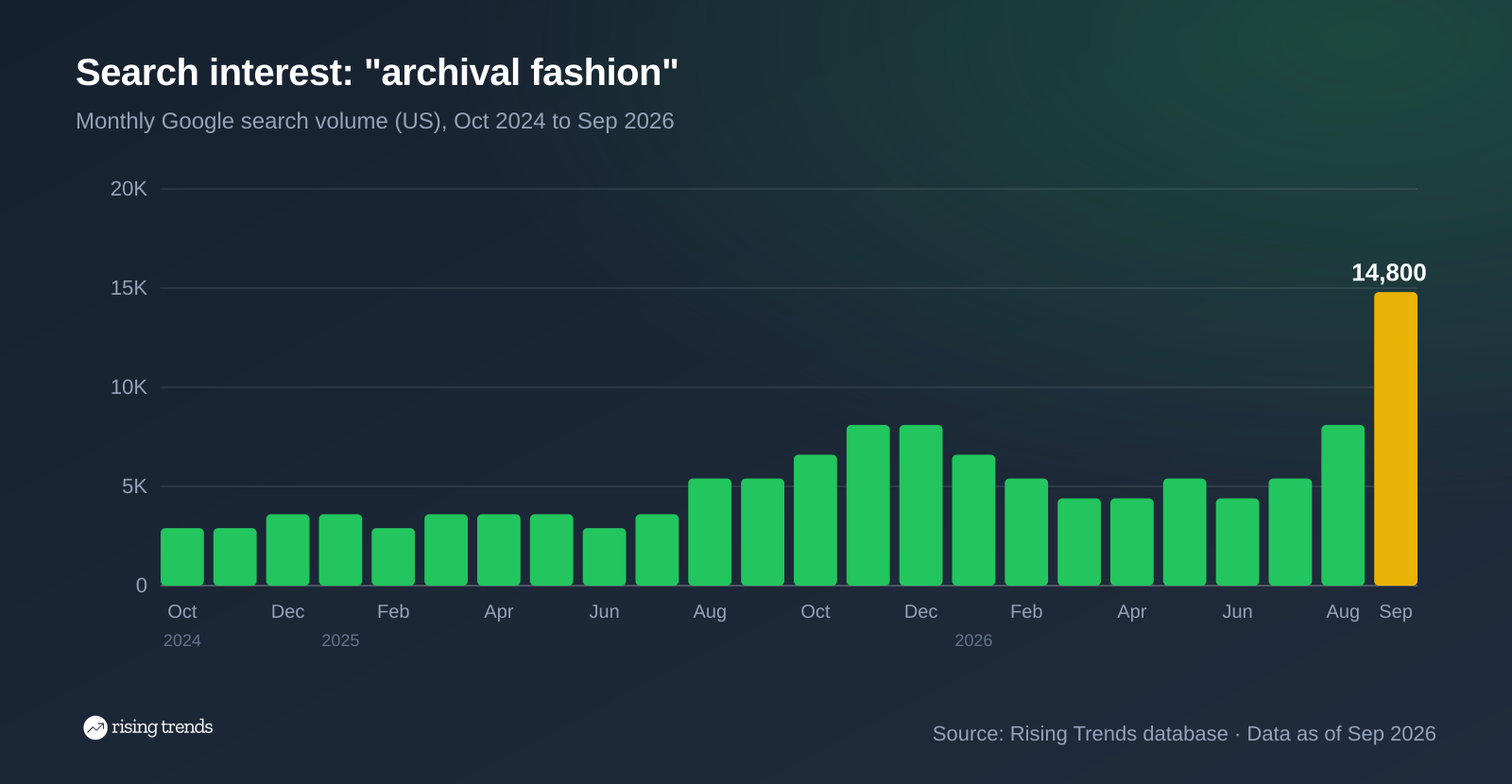
The shape is unusual for a fashion term. It is not a single spike and it is not a smooth climb. The line sits near 2,900 through most of 2024, lifts for the first time in August 2025, holds around 8,100 through the winter, fades back through spring, and then doubles twice in two months. Our seasonality flag on this term reads HIGH, which fits: archive buying tracks the fashion calendar and the gifting season, not the news cycle. What does not fit a seasonal pattern is the level. September 2026 came in at nearly three times September 2025.
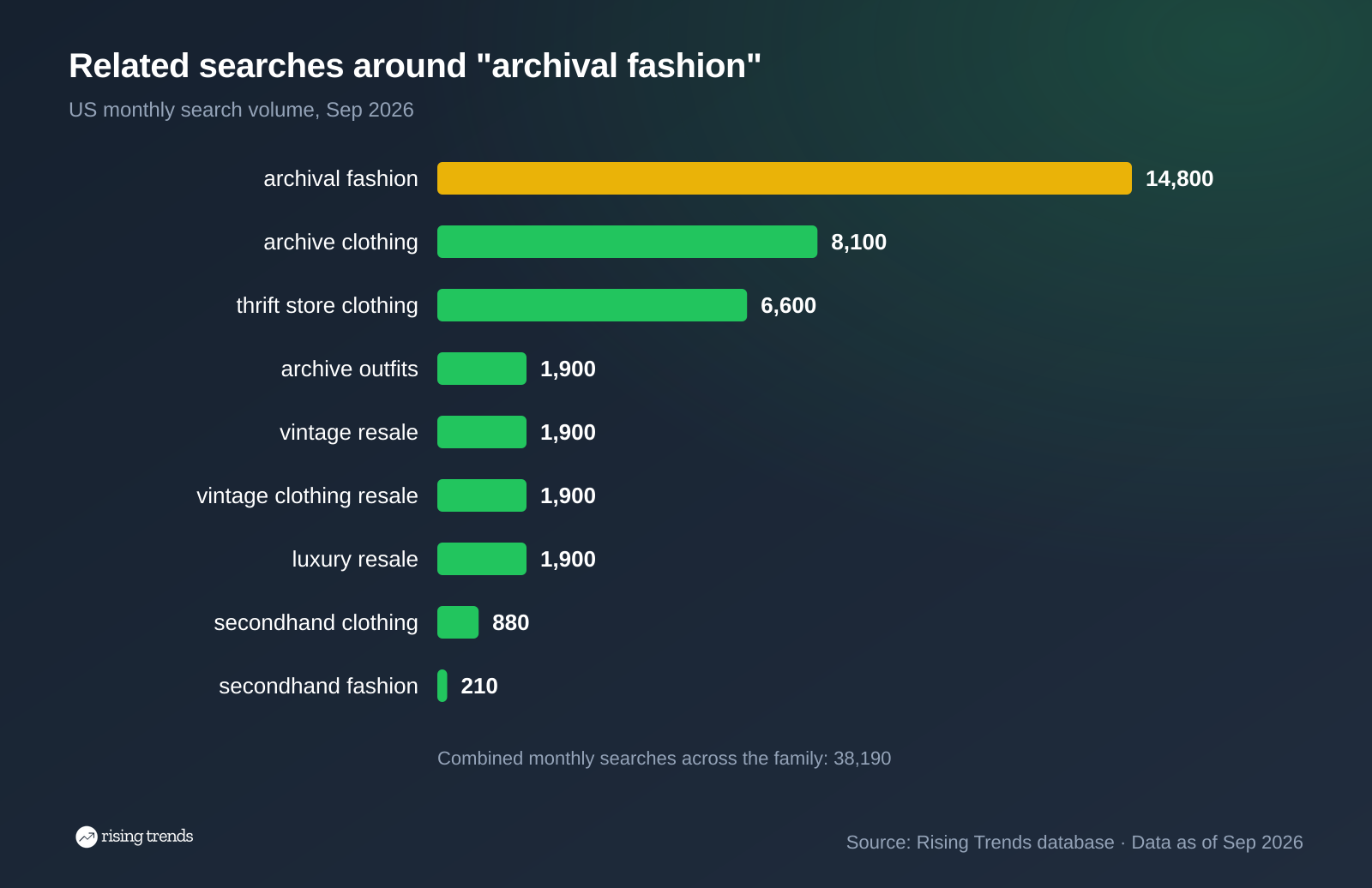
The more useful view is what is happening to everything next to it. We pulled the eight closest terms in our database and ranked them by one-year growth.
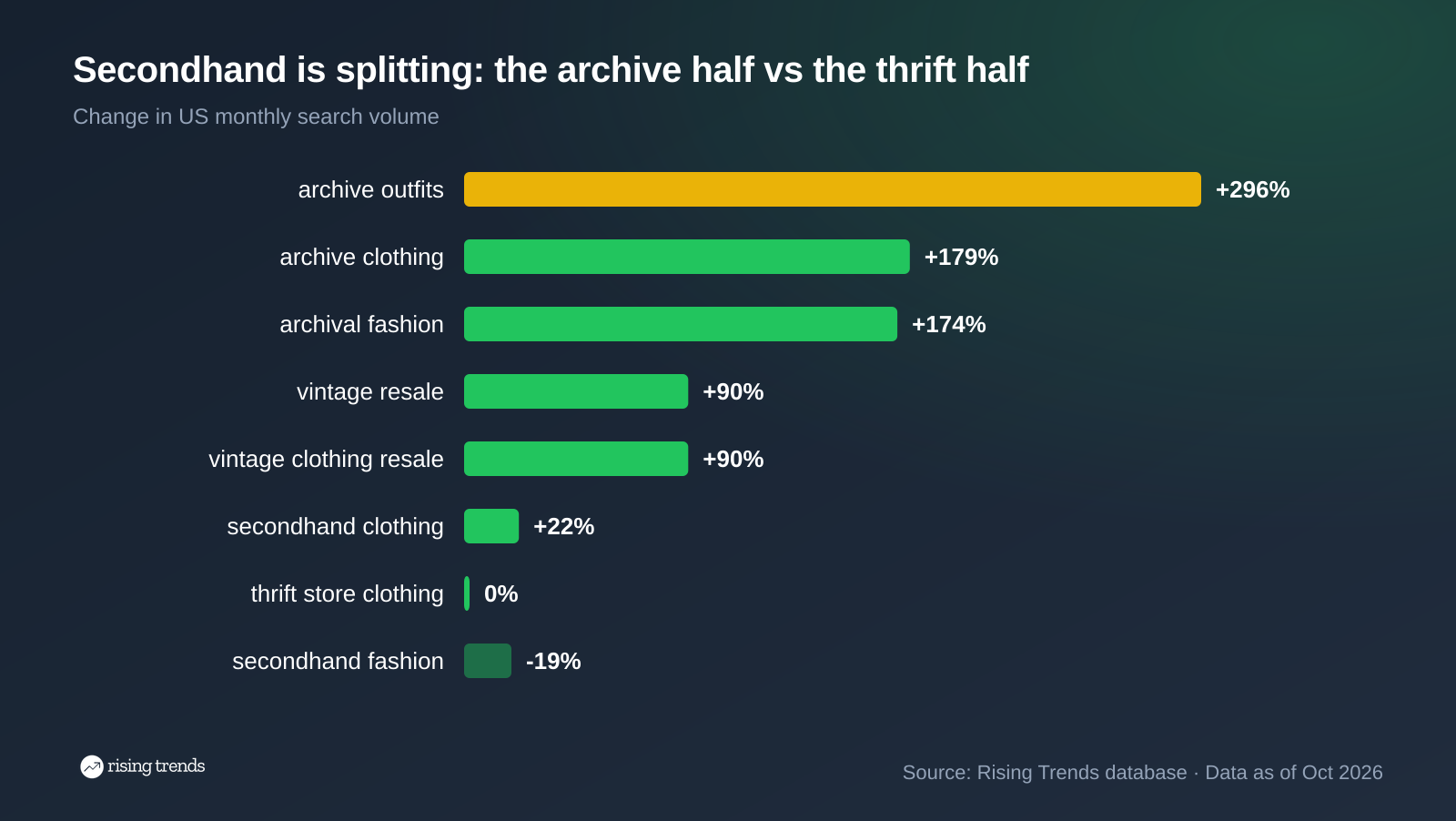
Read it top to bottom and the market sorts itself into two halves. Everything with "archive" in it is compounding: archive outfits up 296%, archive clothing up 179%, archival fashion up 174%. Everything that describes buying used clothes in general has stalled. "Thrift store clothing" is flat at 6,600 searches and down a third over two years, and "secondhand fashion" is shrinking outright. "Vintage resale" sits in the middle at 1,900, up 90%, which is the point where the two vocabularies meet.
This is not more people shopping secondhand. It is the same behaviour splitting into a general tier and a collectors' tier, with the collectors' tier taking the growth and inventing its own words to do it.
What archival fashion actually is
An archive piece is not simply an old piece. The working definition inside the community is a garment from a specific designer's specific tenure at a specific house, usually one that mattered to the house's direction: Helmut Lang before 2005, Raf Simons at Jil Sander, Hedi Slimane at Dior Homme, Tom Ford at Gucci. Vintage is defined by age, and the trade convention is 20 years or more. Archive is defined by provenance. A 2014 Celine coat can be archive. A 1985 jacket from a brand nobody researches is vintage.
The people who do this professionally are strict about it, and uneasy about how fast the word is spreading. Michael Kardamakis founded ENDYMA in Berlin in 2014 and holds what its own site calls the biggest collection of vintage Helmut Lang in the world, 261 Helmut Lang pieces listed at the time of writing, most of them rented to designers rather than sold. Asked about the term in Nasty Magazine's archive column, he said he avoids it because it is "very trendy and buzzy nowadays", and added the line that explains the whole problem: "People are labelling pieces as archive that is not really archive."
Valentina Cognini, a fashion archivist who has worked at the Roger Vivier archive, framed the other side of it in the same piece: "Conserving the past is crucial for the future of fashion." That is the institutional view, the one the V&A's fashion collection has held for a century. What is new is that it is now a consumer behaviour with a resale price attached.
You can watch the word stretch in real time on the platforms.
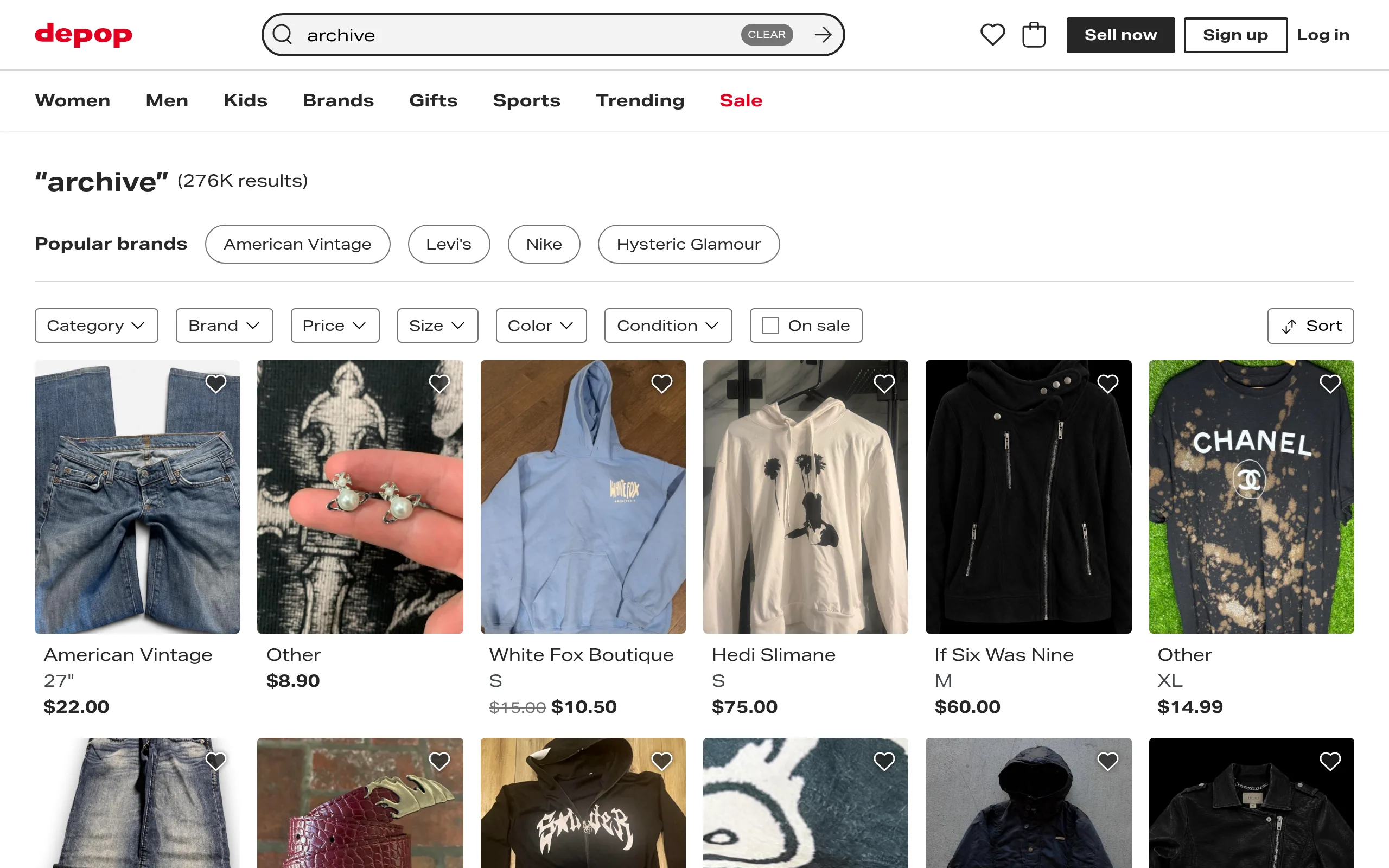
That is 276,000 listings matching "archive" on a single platform, against 1.29 million for "vintage" and 750,000 for "thrifted" on the same day. The first row of results runs from a pair of $8.90 earrings and $22 American Vintage jeans to a $75 Hedi Slimane piece. Some of that is archive. Most of it is a seller who has learned which word moves a listing. As the writer of that Nasty column put it, archive "is just sexier than vintage".
Why it's trending now
Three things landed at once, and only one of them is a meme.
The first is turnover at the top of the industry. Chanel, Dior and Gucci all changed creative direction inside eighteen months, and every change sends buyers backwards into the house's old work. On 10 November 2026, eBay put numbers on it in its Fall/Winter Watchlist Trend Report, drawn from 136 million active buyers and about 2.7 billion live listings. As searches rose for Matthieu Blazy (up 291%), Jonathan Anderson (up 92%) and Demna (up 42%), the archives moved with them: listings for Karl Lagerfeld-era Chanel climbed 87%, average sale prices for John Galliano-era Dior rose 81%, and listings for Tom Ford-era Gucci rose 49% year over year. Loewe and Bottega Veneta reissuing their own old bags pushed global listings for the Amazona 180 and the Veneta up 440% and 158%.
The second is the auction houses reclassifying clothes as collectibles. Sotheby's is selling Princess Diana's 1994 Christina Stambolian dress on 9 December 2026 as a standalone, single-lot sale.
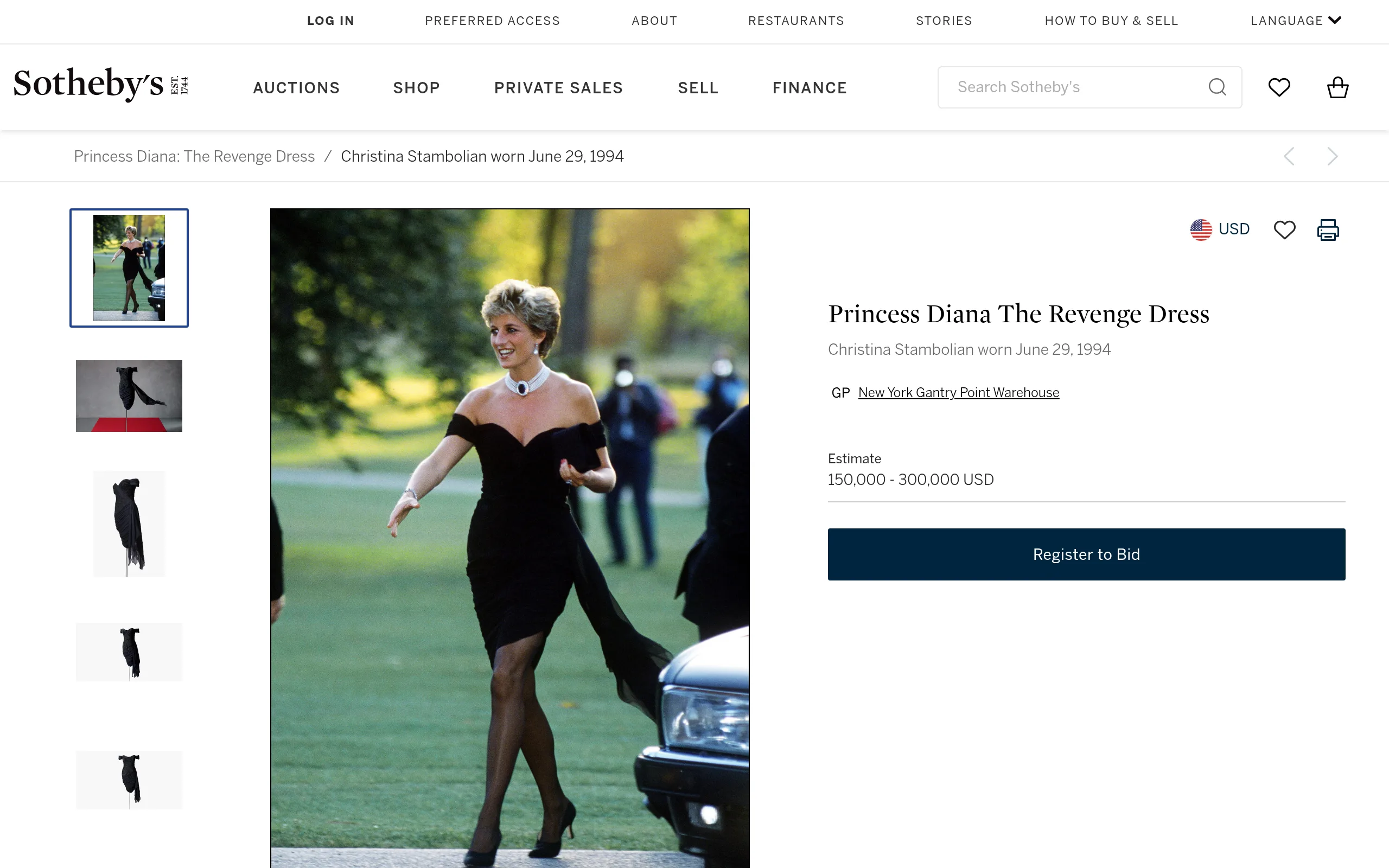
The estimate is $150,000 to $300,000, and the provenance line on that page traces the dress to Christie's New York in June 1997. Morgane Halimi, Sotheby's global head of handbags and fashion, described the piece by what it communicated rather than who wore it: "Fashion can be a language when words fail or are simply not enough." The dress went on public view in London from 18 September, which is the month our curve peaked, then toured Hong Kong, Geneva and New York.
The third is that the explainers finally arrived. This video essay on the history of the category went up on 7 November 2026 and has 264,026 views as of 20 November.
A quarter of a million views on an eleven-minute explainer, from a channel whose previous hit was an argument about polyester as a mark of cheapness, tells you the audience arrived before the vocabulary did.
The new behaviour: buying by provenance, not by price
The old secondhand transaction was a price transaction. You looked for the thing you wanted, cheaper. The seller's job was to prove condition, and the buyer's question was "how much less than retail".
The archive transaction is a provenance transaction. The buyer's question is which house, which designer, which season, which year, and the answer is the product. Hedi Slimane at Dior Homme in 2005 is a different item from Dior in 2005, even when the label is identical. Sellers who can supply that string get paid for it, and sellers who cannot are selling vintage at vintage prices. That is the whole mechanism behind the divergence in the chart above.
Two consequences follow for anyone selling clothes.
The price stops tracking condition. A worn Raf Simons piece from the right season can carry a multiple of a mint piece from the wrong one. That is collecting logic, not retail logic, and it is the same logic that made a $400 watch outsell the luxury category in our Swatch AP data and that sets the floor under the Satoshi Vans resale market, where a $160 shoe traded near $1,000 before the search term even broke out.
The reference moves faster than the garment. On 18 November 2026, Hailey Bieber wore an archival Yohji Yamamoto look to the New York Times DealBook Summit and the read, within hours, was Carolyn Bessette-Kennedy in 1998. Nobody needed the provenance explained. A reference that would have been a footnote five years ago is now the headline, and the search traffic follows the reference rather than the brand.
Who's building on it
The category already has a full stack, from $9 listings to six-figure lots.
The marketplaces are consolidating around it. eBay agreed in February 2026 to buy Depop from Etsy for approximately $1.2 billion in cash. The release gives Depop about $1 billion in gross merchandise sales for 2025, nearly 60% year over year growth in the US, 7 million active buyers with nearly 90% under 34, and more than 3 million sellers. eBay's own fashion business is more than $10 billion in annual gross merchandise volume. Depop's facts page puts it at roughly 56.3 million registered users and up to 600,000 new listings a day, which is the supply side of all those archive tags.
The specialists are renting, not selling. ENDYMA's model is the tell. The collection exists to be studied and borrowed by designers, with only a slice offered for purchase. When the inventory is treated as reference material rather than stock, the business looks more like a library than a shop.
The auction houses have opened a lane. A single dress with its own sale and a $300,000 ceiling is not a resale listing. It is an asset class being tested in public.
The volume end is still the volume end. ThredUp's 2026 Resale Report puts the global secondhand apparel market at $393 billion by 2030, growing twice as fast as apparel overall, with CEO James Reinhart warning that it is "entering a more competitive, structurally complex phase". Our data says where that complexity is: not in more people buying used, but in the gap opening between the half that can name a designer and the half that cannot.
What it means for business
Luxury resale platforms have a positioning problem. "Vestiaire Collective" sits at 40,500 monthly searches as of September 2026 and is down 18% over the year and 45% over two. The curated-luxury pitch was built for a market that wanted authenticated designer goods at a discount. The archive buyer does not want a discount, they want the right year, and they are finding it on general marketplaces and in specialist shops instead.
Brands should expect their own back catalogue to compete with them. Every reissue of an old bag lifts listings for the original, as Loewe and Bottega Veneta just demonstrated at 440% and 158%. Houses that treat their archive as marketing material are also, now, seeding a secondary market that prices their old work against their new work.
Provenance is the product feature worth building. Authentication solved "is it real". The open problem is "is it the one", and nobody has shipped a good answer: season tags, lookbook matching, runway cross-reference. Whoever makes that cheap gets the margin, in the same way the dupe economy was won by whoever made comparison cheap, which is the pattern behind the Lola blanket dupe trend.
The word will get worse before it gets better. The 276,000 Depop results are a warning. When a tag adds price, every seller uses the tag, the tag stops meaning anything, and buyers migrate to the next signal. We have watched that cycle run in collectibles, where Labubu searches collapsed once the price of the feeling caught up with the object.
Where this is heading
Three calls, each with something in our data to watch.
The archive vocabulary keeps taking share from the thrift vocabulary. The signal is "archive clothing" at 8,100 searches and up 179% in a year against "thrift store clothing" at 6,600 and flat. If archive clothing passes thrift store clothing outright in the next two quarters, the renaming of secondhand is finished, not starting. Our clothing trends tracking already has resale as the category's biggest single movement.
Someone sells provenance as a service. Rental archives like ENDYMA prove designers will pay for access to verified history. The consumer version, a paid lookup that tells you the exact season and show a garment came from, is the obvious next product, and the first platform to bundle it into listings will take the collectors' tier with it.
The auction result on 9 December sets the ceiling. If a 1994 dress clears its $300,000 high estimate, every house with a wearable archive revalues what it is sitting on, and the luxury category gets a new comparable. If it lands at the bottom of the range, the reclassification slows down and archive stays a street-level behaviour.
The thing we keep coming back to is the asymmetry. Secondhand clothing as a phrase is flat. Secondhand clothing with a designer, a season and a year attached is up 174% in a year. Same garments, same platforms, same shoppers. The only thing that changed is how much people know, and how much that knowledge is worth.
Want to catch the vocabulary shift before the prices move? Read our guide on how to identify market trends, or browse what is breaking out right now in our trending topics list.
Never miss a trend again
- One trend broken down with the numbers
- Who's making money, and what to build
- A website on the rise
- A breakout app
Join 5,000+ founders