Trends


For eight straight months, almost nobody searched for "ramp stack." Our database shows a flat line at 10 searches a month from September 2025 through April 2026. Then Ramp launched the product on June 3, 2026, and the term hit 3,600 searches that month. It has settled at 1,000 a month as of August 2026, which is still up 9,900% on the year.
Here is the part nobody ranking for the term has noticed. The parent brand, "ramp," draws 301,000 searches a month and grew 50% over the same year. "ramp ai" grew 23%. "ramp software" did not move at all. One four-month-old product inside a $44 billion company is now outgrowing every other term the company owns, by two orders of magnitude. That is the story, and the numbers behind it are ours.
Key takeaways:
Let's get into it.
The curve is the cleanest launch signature we have seen this year. Nothing, then everything, then a floor three times higher than the nothing.
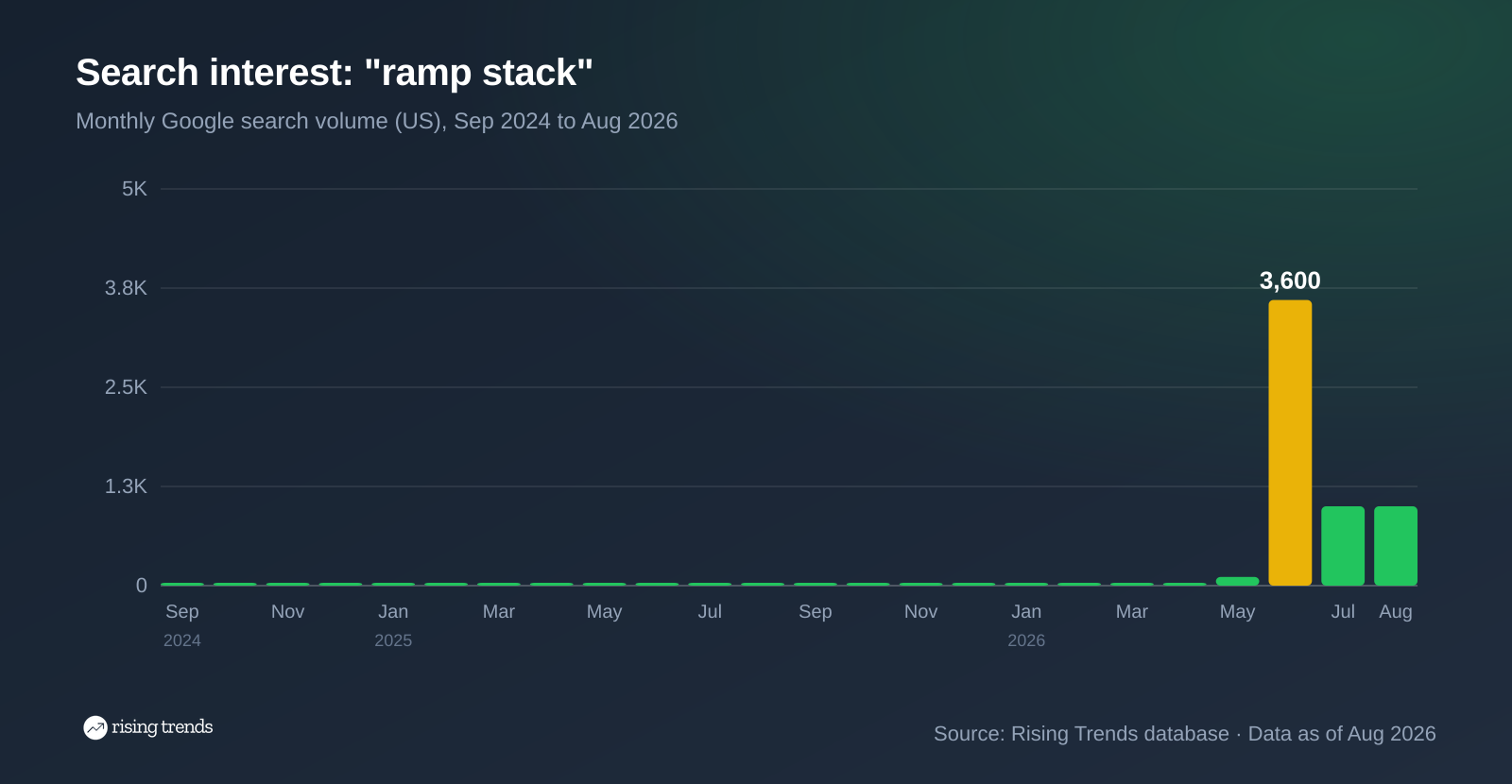
Read it month by month. May 2026 is 110, the pre-announcement leak of curiosity. June 2026 is 3,600, the launch. July and August are both 1,000. That last number matters more than the spike does. A launch that collapses back to its baseline was a press cycle. This one kept roughly 28% of its peak for two consecutive months, which is what a product with users looks like rather than a product with coverage.
Now put it next to everything else Ramp owns.
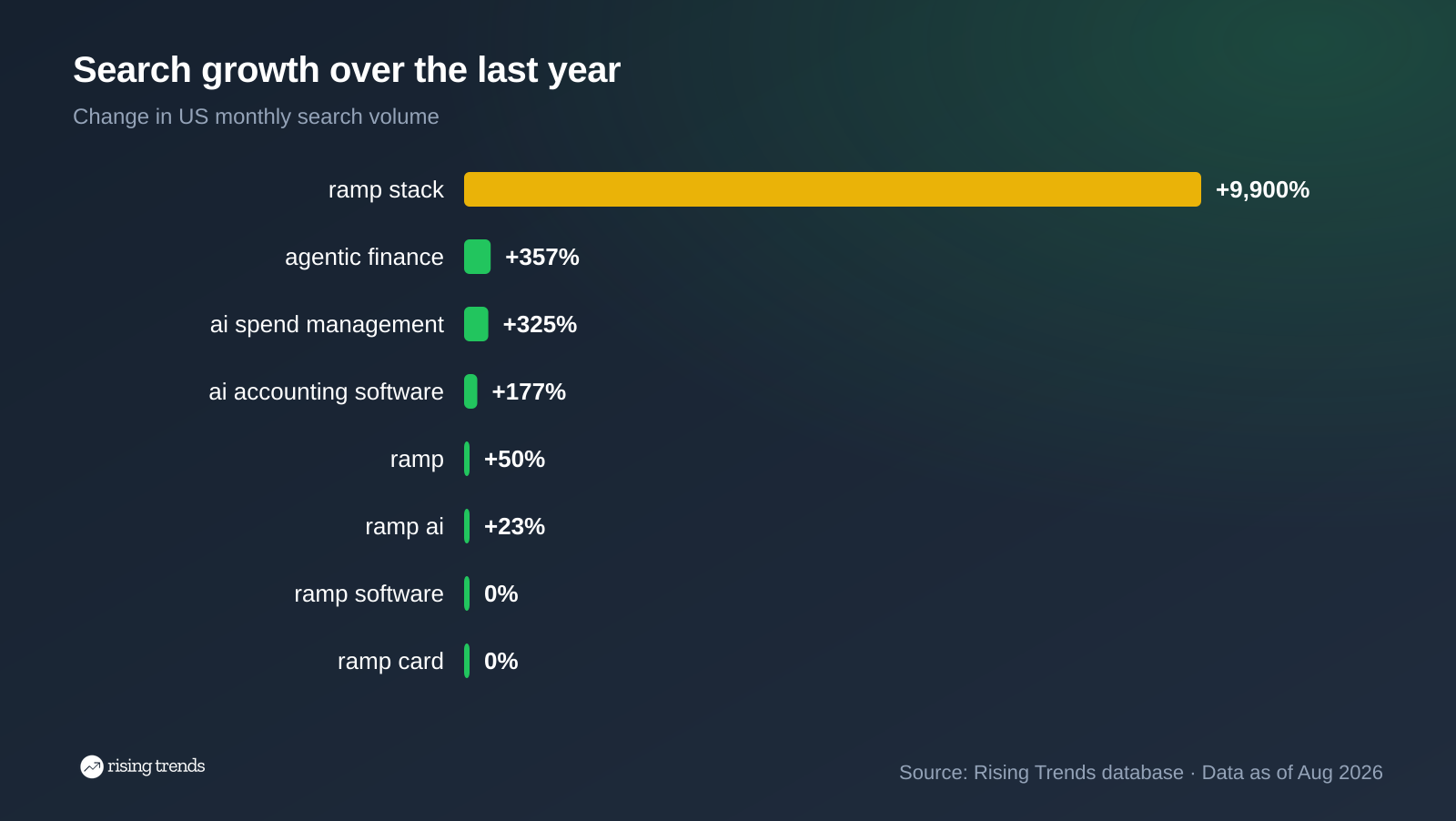
"ramp card," the term for the business that built the company, is flat. "ramp software" is flat. "ramp ai," which Ramp has been pushing for two years, grew 23%. The category terms are moving faster than the brand terms: ai accounting software is up 177% to 3,600 a month, and agentic finance is up 357%. The product term beat all of them from a standing start.
In absolute volume, though, Stack is still the small one.
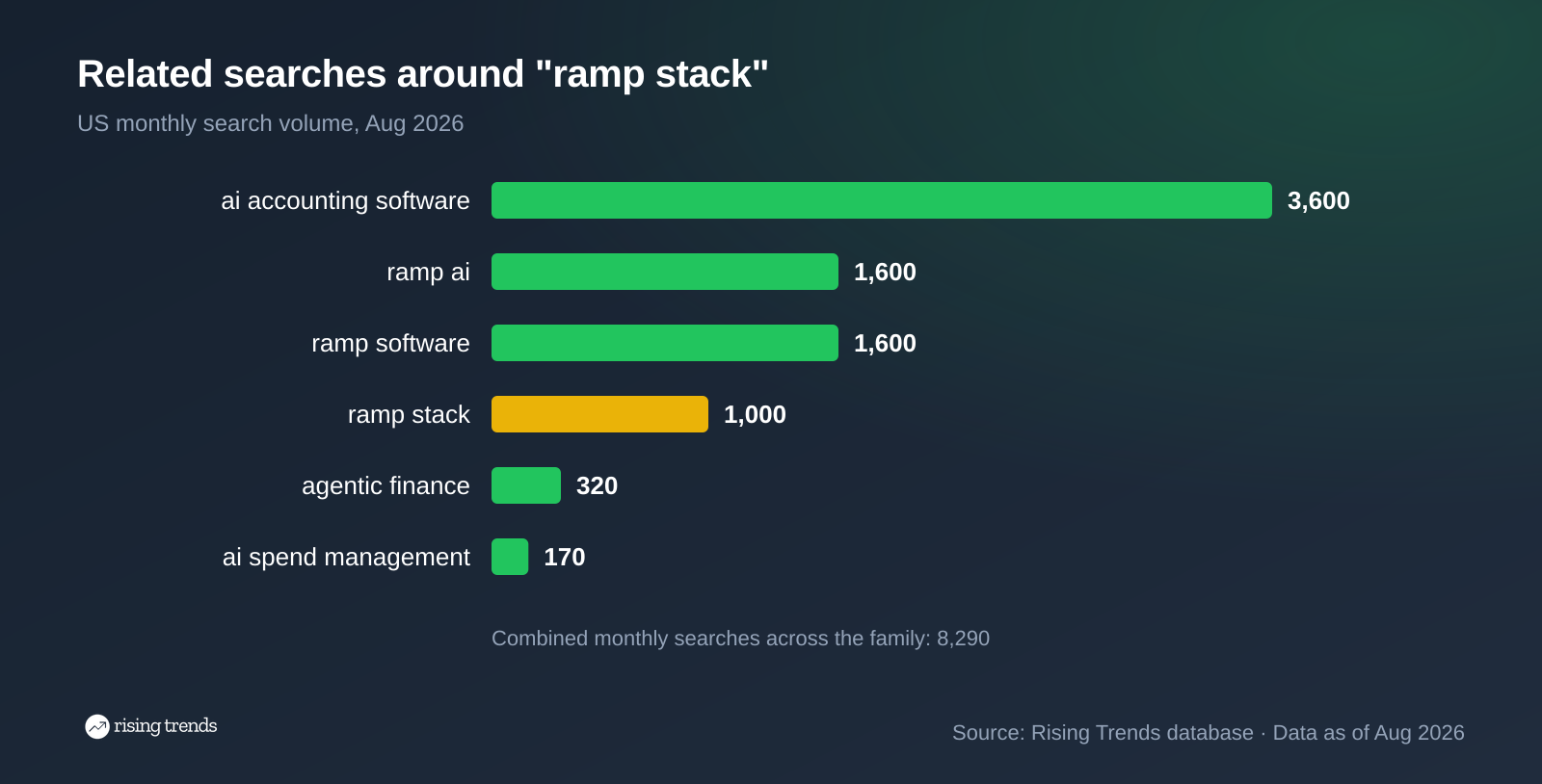
That gap between growth rate and absolute volume is the honest read on where this product is. A thousand searches a month is a few thousand accountants, not a market. The growth rate says the market is forming. The volume says it has not formed yet.
Ramp calls Stack "the AI operating system for today's top finance teams." Strip the phrasing and it is an agent that does accounting work, plus the plumbing that makes the work reviewable.
The unit of the product is a Skill: a codified standard operating procedure. How your firm reconciles a bank account. How it rolls a prepaid schedule forward. How it books a recurring accrual. The agent reads a task off a close checklist, matches it to a Skill, pulls the data and prepares the work. Ramp says Stack ships with a starter set covering reconciliations, journal entries, variance analysis, schedules and accruals, and expects firms to edit them and write new ones.
The connectors are the other half. Ramp's product page for Stack lists QuickBooks, NetSuite, Sage Intacct and spreadsheets, with push, pull, read and write access. Everything it does lands in a Session Audit Log, and nothing posts to the ledger until an accountant approves it. Ramp runs it on SOC 2 controls and says its contracts with the foundation model providers include zero data retention.
The headline claims on that page are up to 60% faster closes and up to 9x faster recurring schedules and reconciliations. Those are vendor numbers measured by the vendor, so treat them the way you would treat any seller's benchmark.
What is unusual is that Ramp published the benchmark itself.
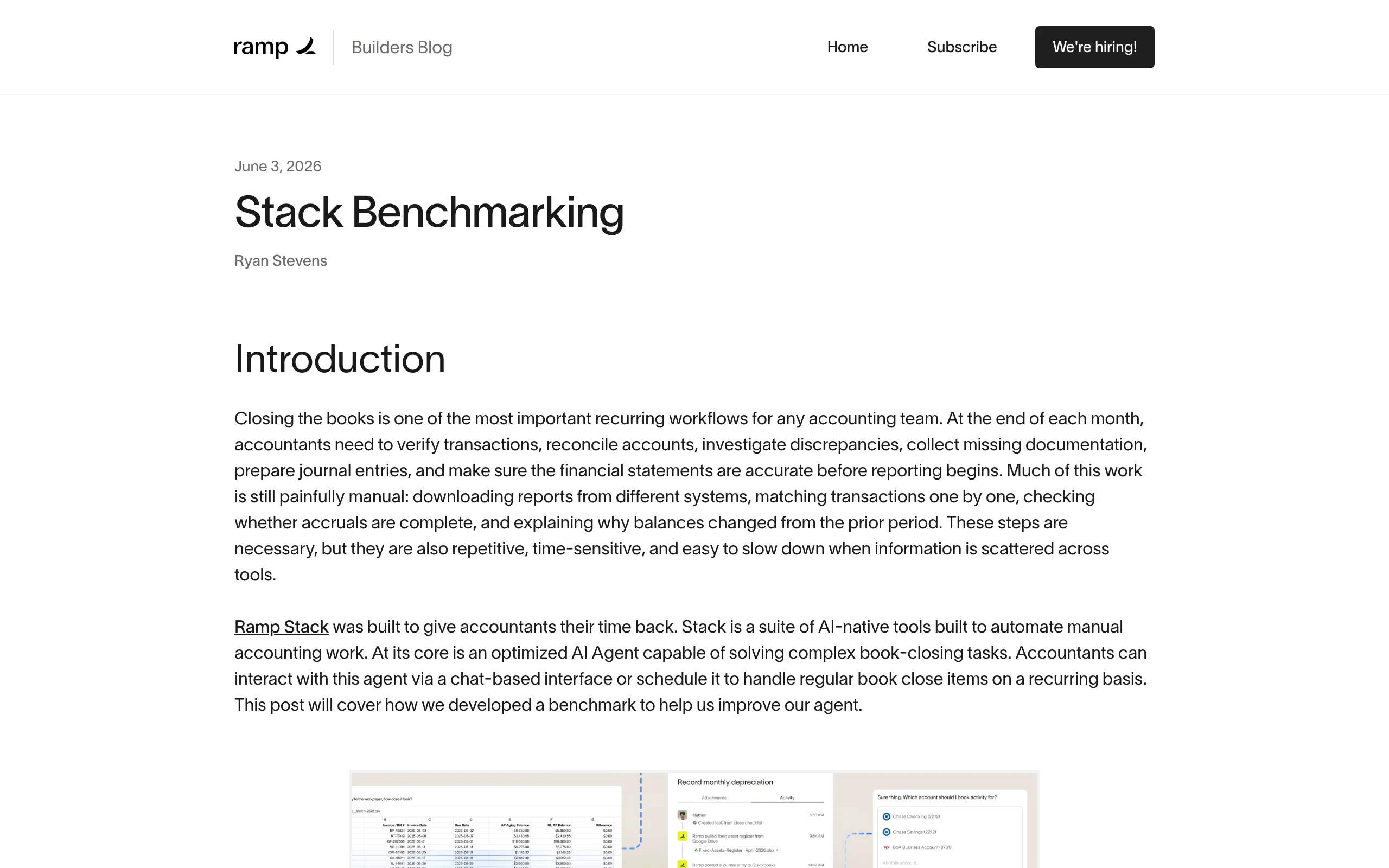
That post, Stack Benchmarking by Ryan Stevens, is the most useful document Ramp has put out about the product, and it went up the same day as the launch. It describes eight synthetic businesses, from a DTC ecommerce brand to a construction company running percentage-of-completion revenue across four projects. Across that slice there are 237 tasks and 3,469 grading criteria, written by working accountants. A task score is the fraction of criteria the agent satisfied.
The findings are more candid than marketing usually allows. When Ramp tested its own skill library one skill at a time, only two of seven helped on average. The rest were neutral or negative, so Ramp pruned them. Its spreadsheet skill was cut from 14,000 characters to 5,000, a 64% reduction, with no measurable loss. And memory, the thing that makes the agent remember how your firm does things, moved the mean score from 56.0% to 61.5%.
Memory also backfired in a specific, instructive way. On one roll-forward task, a workers' compensation accrual, the agent scored 0% without memory and 100% with it. On another, an AIA progress billing, memory dragged it from 75% down to 25%, because the stored note carried last period's contract details into a period where they no longer applied. Ramp's conclusion is worth repeating: the goal is not to write more memory, it is to write memory that generalises.
The pitch is not efficiency. It is staffing.
Ramp's launch announcement opens on a labour shortage: more than 300,000 CPAs have left the profession, accounting degrees hit a 20-year low last year, and firms are turning away clients because they cannot staff them. The addressable market it names is roughly $150 billion. Ramp also says it already partners with more than 4,500 accounting firms, and that 92 of the top 100 CPA firms have clients on its platform. That distribution is the real reason this launch moved a search curve at all.
Geoff Charles, Ramp's chief product officer, framed the product against the chatbots firms were already trying: "The firms we work with aren't asking for another AI tool to prompt. They need something that actually does the work, with every decision reviewable and auditable."
The testimony Ramp published alongside it is vendor testimony, and worth reading as such. Tyler Otto of Specialized Accounting is quoted saying Stack "is eliminating or reducing the amount of time we spend on a month-end close by 50% on some clients." In Ramp's design partner write-up, the same person describes how he approached the trial: "I said, 'Ramp, don't hold back. I want to try and break this thing.'" The most concrete anecdote in that post is a fractional controller, Dana McMillon, uploading a client's sales tax workbook from a parking lot on the way to her son's basketball game, getting March finished twenty minutes later, and saving the result as a Skill so the next month took minutes.
Independent reaction is thinner, because the product is four months old and sells to firms rather than to consumers. The closest thing to a review is the accounting podcast UnAccountable!, which put Stack and rival Ask Double side by side in an episode published on October 8, 2026.
Two working accountants comparing the AI assistants now pitching them is roughly where the category sits in late 2026: interested, unconvinced, and shopping.
The competitive set formed fast, and it splits on one question. Who writes the automation?
| Product | Model | Where the firm's work starts | Ledgers in production |
|---|---|---|---|
| Ramp Stack | Firm writes and maintains Skills, agents run them | Building the Skill, then approving each posting | QuickBooks, NetSuite, Sage Intacct |
| Meridian (Pilot) | Close workflows ship pre-built | Reviewing the finished close | QuickBooks Online, Xero |
| Basis | Vendor team embeds and builds agents for the firm | After a months-long implementation | QuickBooks-primary firms |
| General-purpose chatbots | Accountant prompts, copies output back by hand | Every single task, from scratch | None, no ledger write access |
The sharpest criticism of Stack comes from a competitor, so weigh it accordingly. Pilot's buying guide on Ramp Stack alternatives, published in September 2026, argues that a skills-based tool asks the firm to do the implementation work before any automation pays off: document each client's close in enough detail for an agent to follow, test the skill, then fix it when it drifts. Its second point lands harder. If the agent pauses before every posting for approval, the accountant ends up supervising the work piece by piece rather than reviewing finished books. Its third is the quiet one: plenty of firms have no written SOPs at all, because the close lives in one senior accountant's head.
That guide also claims Stack posts only to QuickBooks Online today, which conflicts with Ramp's own connector list. Treat the rival's version as a rival's version.
What Ramp has that none of them do is incumbency in the data. Spend, accounts payable and banking data for tens of thousands of businesses already run on Ramp, so the agent reads live numbers rather than an imported copy. Every other entrant in this table is negotiating for access to books that Ramp is already inside. That is the same structural advantage we saw when the company shipped Router.com and cut customer inference bills 40% on average: Ramp ships infrastructure into a seat it already occupies.
Billable hours are the thing being repriced. Reconciliation has been billed by the hour for a century. If an agent runs it in twenty minutes with an accountant reviewing, the hour stops being the unit of sale. Firms that price by time lose revenue by succeeding. Firms that price by client or by outcome do not. That repricing, not the software licence, is the real decision a managing partner is making here.
The moat moves to process, not people. Ramp's design partners kept raising the same worry: their processes are their competitive advantage, and handing them to a platform is a risk. Ramp's answer was firm-level permissions that keep Skills scoped to the firm. If that holds, a firm's documented close becomes an asset it owns rather than tribal knowledge that walks out when a senior leaves. If it does not hold, firms will have paid to standardise their own differentiation.
Audit trails become the product feature that matters. Every claim Ramp makes about Stack routes back to traceability: formula-backed workpapers, a session log, approval before posting. That is not a nice-to-have in a regulated profession, it is the only way an agent gets near a ledger at all. The same constraint is shaping every serious deployment in our 2026 AI agents report: agents sell into regulated work only when they can show their work.
The small-business end gets squeezed from below too. Bookkeeping for small firms is already being automated by cheaper tools, a shift we tracked in AI bookkeeping, where "ai accountant" reached 6,600 monthly searches. Stack competes at the firm end of that market. The pressure is arriving from both directions at once, which is the pattern across the wider fintech trends of 2026.
Does the floor hold or fall? The single number to watch is whether "ramp stack" stays above 1,000 a month. It has held for two months as of August 2026. If it falls back toward the pre-launch 10, Stack was a launch; if it climbs past the 3,600 peak, it is a category. The live ramp stack trend page is where that resolves first.
Does the category term rise with it? If Stack is creating demand rather than capturing it, "ai accounting software" rises alongside it. That term is already at 3,600 a month and up 177% on the year. Watch the two together: a product term growing while its category is flat means the company took share. Both growing means the market is new.
Does the roadmap reach tax and audit? Charles has said the goal is an operating system where firms run any workflow, naming tax, audit and advisory. Stack shipped fixed-asset handling in September 2026. Tax is the test, because tax is where the liability is, and no agent has gone near it yet.
The broad signal is one we keep seeing in terms like agentic finance, up 357% in a year and 31,900% in two. For a decade, finance software promised to help accountants work. The products launching now promise to do the work and ask the accountant to check it. That is a different product, a different price and a different profession. The search curve for one four-month-old product does not settle which way it goes. It does tell you the question is live.
For the wider picture on where this sits, our 2026 AI trends hub tracks the category terms around it.
Want to spot the next breakout product before the launch coverage lands? Read our guide on how to identify market trends, follow the live ramp stack dashboard page, or browse what is breaking out right now on the Rising Trends dashboard.
Join 5,000+ founders · Free