Trends


Two years ago nobody typed "ai mode google" into Google. As of July 2026 it is 135,000 searches a month, an all-time high, and the term has been classified EXPONENTIAL in our database since the spring. Add the other way people phrase it, "google ai mode" at 450,000 a month, and this is one of the largest product-search stories on the internet right now.
Here is the part nobody ranking for the term has put together. While demand for the feature exploded, demand for the industry built to game it went the other way: "generative engine optimization" is down 46% year over year. Google's own documentation says the quiet part out loud, that there is nothing extra to do. So we pulled the monthly curve, the family of related terms, and the two independent studies that actually measured what AI Mode does to clicks and prices. That comparison is below, and it exists nowhere else.
Key takeaways:
Let's get into it.
Here is the monthly volume for "ai mode google" over two years, straight from our database.
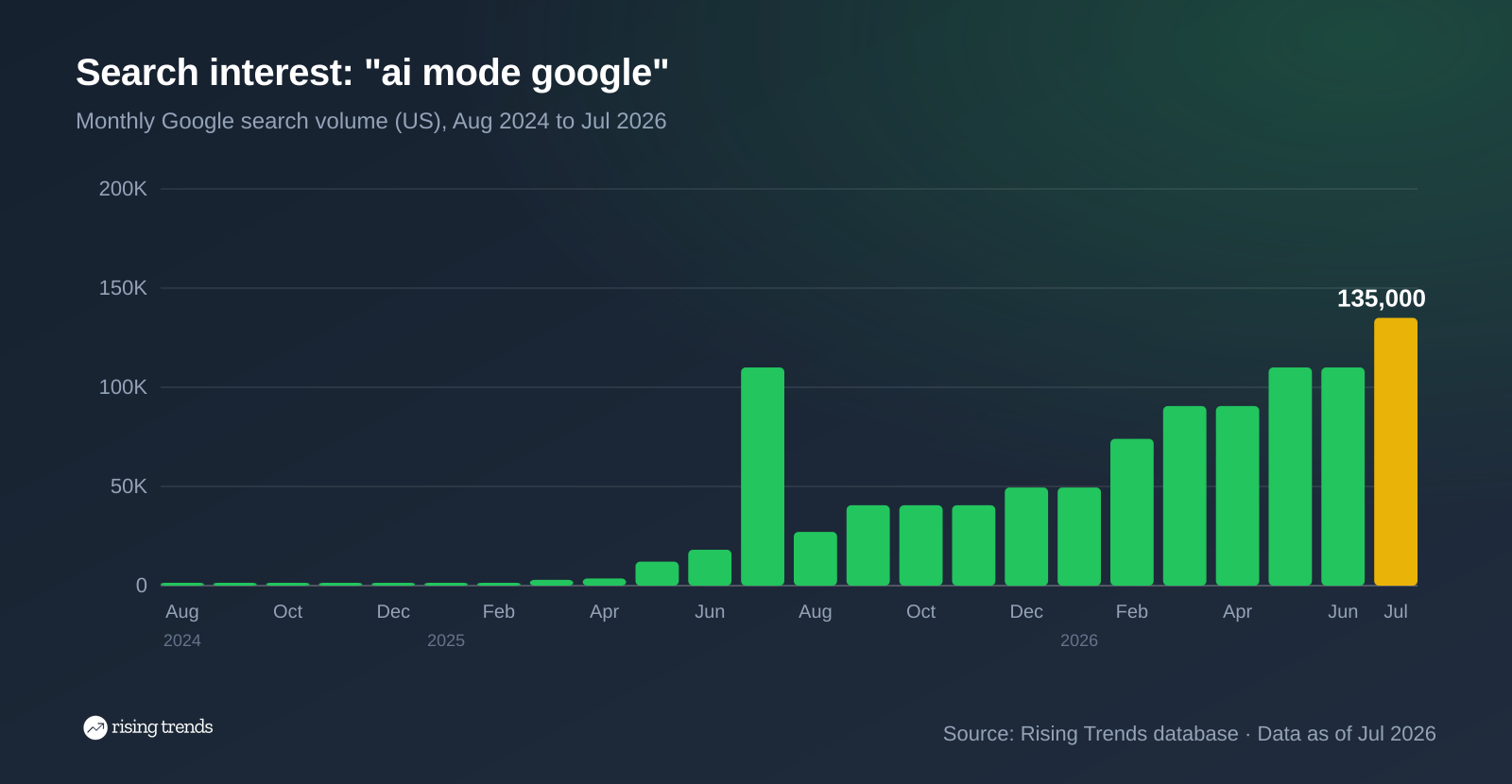
That chart has two different stories in it. The tall green bar in July 2025 is a spike: 110,000 searches in one month, weeks after Google threw the feature open to everyone in the US, then a collapse to 27,100 by August. That is what curiosity looks like. It burns and it goes.
What came next is the interesting part. From August 2025 the line climbs and never gives a step back: 40,500 through the autumn, 49,500 over the new year, 74,000 in February 2026, 90,500 in the spring, then 110,000 and a fresh peak of 135,000 in July 2026. Twelve months, no down month, acceleration of 1.39 comparing the last three months against the three before. A spike and a staircase look nothing alike, and only the monthly series tells them apart.
Now put the term next to its neighbours.
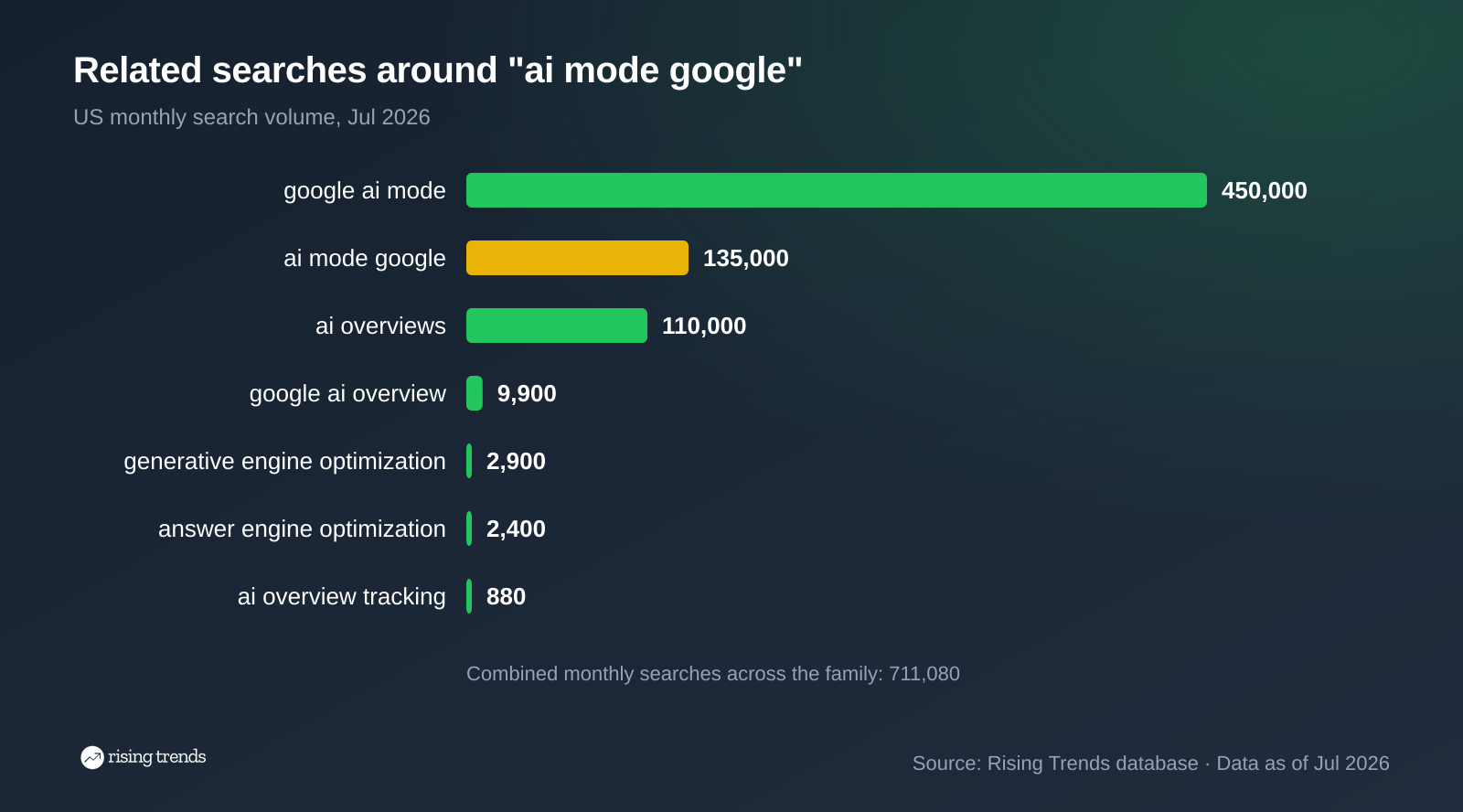
Seven terms, 711,080 monthly searches combined as of July 2026. The top three are people trying to use the thing. The bottom three are marketers trying to rank inside it, and they add up to 5,300 a month. That is a ratio of about 134 to 1 between using AI Mode and optimising for it.
The direction matters more than the size. AI Overviews is up 306% in a year. Generative engine optimization is down 46%. The product is compounding and the acronym invented to sell against it is deflating. Hold that thought until the publisher section.
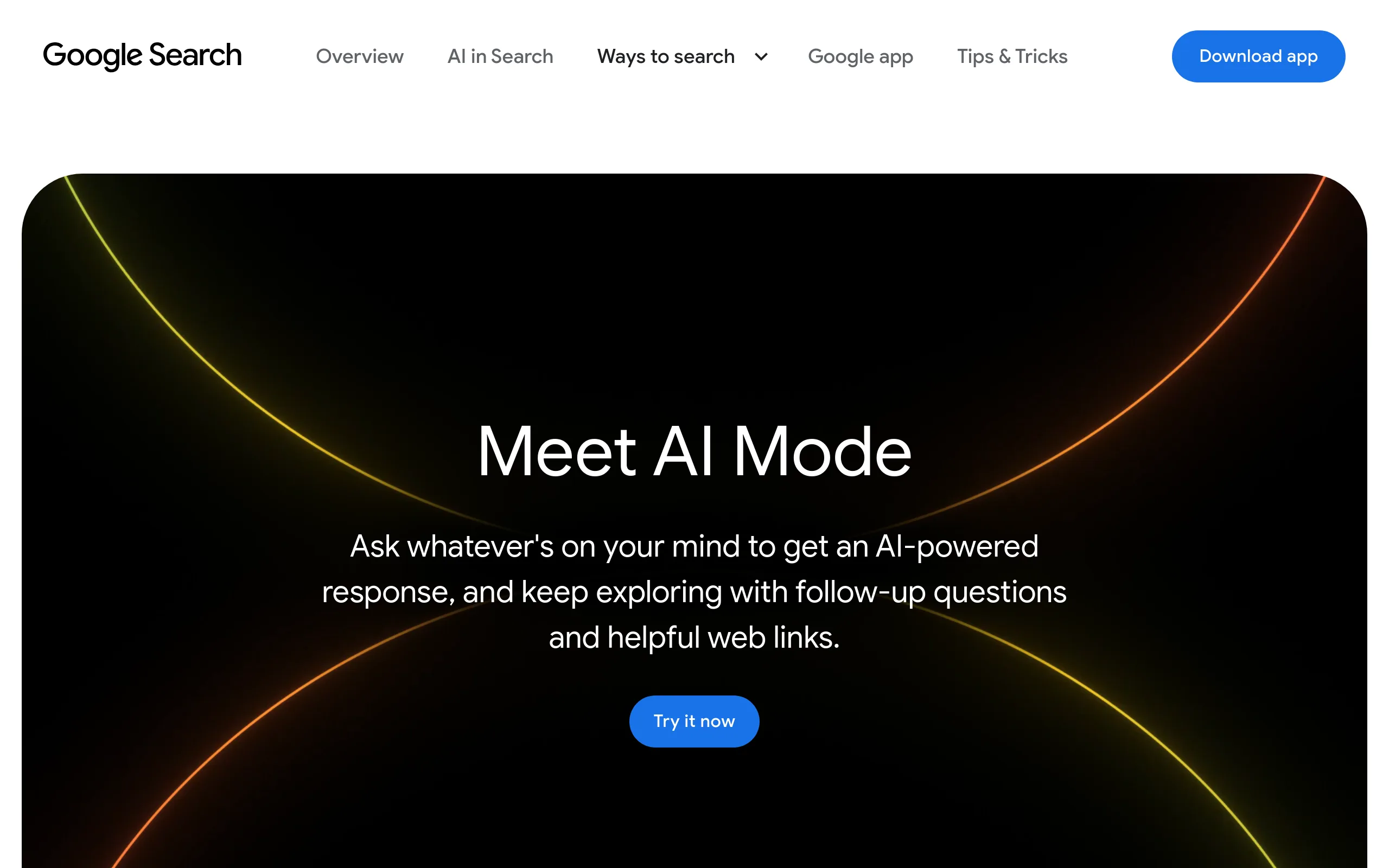
AI Mode is a search mode, not a chatbot in a separate app. You reach it at google.com/ai, from a tab beside the Google search box, or from the home screen of the Google app.
The mechanism Google describes in its original AI Mode announcement is called query fan-out. Your question gets broken into subtopics, a batch of searches runs concurrently across those subtopics, and the model assembles one answer from what comes back. That is why it handles the comparison questions that used to need four separate searches, and why the set of pages it cites often has nothing in common with the ten blue links for the same query.
It is free, it needs no subscription, and Google's AI Mode help page lists availability across more than 200 countries and territories in roughly 100 languages. Signing in and enabling history gets you conversation memory. Opting into the Labs experiment gets you the unfinished features first.
Since April 2026 it also lives inside the browser. Google's AI Mode in Chrome update put the answer and the webpage side by side, so clicking a citation no longer means leaving the answer, and added the ability to pull open tabs, images and PDFs into a query as context. Those shipped in the US first.
Two things drive a search curve like this: a product that keeps changing, and a group of people whose jobs depend on understanding it.
The product side is relentless. March 2025 was a Labs experiment for paying subscribers. May 2025 was the general US rollout at I/O. August 2025 added agentic restaurant booking through Project Mariner and pushed the feature into over 180 new countries and territories. October 2025 was the full global expansion. April 2026 was Chrome. Every one of those is a new wave of people typing the name into a search box for the first time.
The second group is everyone whose traffic runs through Google. Publishers, retailers and agencies have spent eighteen months trying to work out whether AI Mode is a distribution channel or a wall. This panel discussion frames the version of the question that publishers keep asking.
The clip is from The Hub Canada, posted in July 2025, the exact month our curve first spiked. A year later the question is no longer hypothetical, because two studies have measured it.
Same query, same day, two surfaces. Here is what the measured differences look like.
| What changes | Classic Google results | AI Mode | Source |
|---|---|---|---|
| Click on a result link | 15% of visits | 8% of visits with an AI summary | Pew, March 2025 browsing data |
| Session ends after the search | 16% of pages | 26% of pages | Pew, March 2025 browsing data |
| Product overlap for the same query | Baseline | 1.28% of products also appear | Productrise, August 2026 |
| Price of the same matched product | Baseline | 21.6% higher on average | Productrise, August 2026 |
| What you change to appear | SEO fundamentals | Nothing additional | Google Search Central |
The last row is the one people refuse to believe. Google's documentation on AI features and your website is unambiguous: "There are no additional requirements to appear in AI Overviews or AI Mode, nor other special optimizations necessary." It goes further and rules out the specific products being sold: "You don't need to create new machine readable files, AI text files, or markup to appear in these features. There's also no special schema.org structured data that you need to add." Eligibility is the same eligibility as a normal snippet, and the reporting lives in the same Search Console performance report it always did.
That is not the same as saying nothing changed. Eligibility held. Clicks did not.
The reviews split cleanly between speed and accuracy.
On the enthusiastic side, one Hacker News commenter wrote in August 2026 that "Google AI Mode consistently gets me consistently good results and good speeds. It really changes what 'googling' is for me." Google's own commissioned research points the same way, with an Ipsos survey of 13,189 shoppers reported in its Google Marketing Live announcement finding 75% said they make faster, more confident decisions using AI Mode. That is a vendor-commissioned number, and worth reading as one.
The complaints are specific and they are about fabrication. A commenter described asking how to unsubscribe from a company's emails: "Google Search 'AI Mode' confidently gave me a sequence of steps... None of those options existed." Another put the trade-off plainly: "It definitely makes things up all the time, but it gets it right surprisingly often. I really like it."
There is a third complaint worth separating out, because it bears on the billion-user number. One commenter noted that Google "put an 'AI Mode' button where the 'All' button was", so returning from image search lands you in AI Mode by accident. Placement drives some share of that adoption. Nobody outside Google can say how much.
For publishers, the loss is measurable and it is clicks. Pew Research Center's analysis of 900 US adults' browsing data found a click on a traditional result in 8% of visits where an AI summary appeared, against 15% where none did, with clicks on the links inside the summary at 1%. Sessions ended outright on 26% of AI-summary pages versus 16% otherwise. Google's counter, from the Alphabet Q2 2026 earnings remarks, is that it is "sending billions of clicks to websites every week through AI features in Search". Both can be true: a bigger pie, a thinner slice per query.
For retailers, the ranking rules changed underneath the same data. Productrise ran 100,000 SERPs and AI Mode responses across 23 days in August 2026 and found that only 1.28% of products ranking in classic search also appeared in AI Mode for the same query on the same day. Where a product did appear on both, AI Mode's lead price averaged 21.6% higher, the main seller differed on 49.6% of matches, and across all listings the AI Mode set sat 49% above classic search. If your merchandising strategy is built on being the cheapest offer, that lever is weaker here.
For advertisers, the inventory is already live. Google began testing ads inside AI Mode in May 2025 for advertisers already running Performance Max, Shopping and broad-match Search, then added two Gemini-built formats in May 2026 that place an ad inside a recommendation list. Search and Other advertising revenue grew 17% year over year in Q2 2026. This is not a channel Google is protecting the old surface from. It is the new surface. The shift shows up across the advertising trends we track for 2026.
And the optimization industry is selling a map to a road that has not moved. Our data says the vocabulary is shrinking while the product compounds. Google says there is nothing extra to file. The honest advice is the boring advice, which is the SEO work you were already doing: be indexable, be citable, be the page a fan-out query would want. What deserves a rethink is what you measure, because impressions can hold steady while clicks fall, and only one of those pays.
Whether the curve keeps stepping. Our term is at 135,000 and rising, but "google ai mode" at 450,000 is the bigger prize and the faster grower at 508% year over year. If both keep climbing, AI Mode is still onboarding. If they flatten together, the feature has finished recruiting and turned into plumbing. The live AI Mode trend page is where that turn shows up first.
Whether measurement demand replaces optimization demand. "ai overview tracking" is up 319% year over year while the two optimization terms shrink. That is the market voting for instrumentation over tactics. Watch that term: if tracking keeps compounding while GEO keeps falling, the tooling money has already moved.
Whether agents make the browser the surface, not the results page. AI Mode already books restaurants, reads your open tabs and sits beside the page in Chrome. That is the same direction as the AI agents we track for 2026 and the broader generative AI shift: the answer stops being a destination and becomes a step. Retailers and publishers should assume the next integration reduces the number of pages a person visits, not increases it.
The blunt read is this. A billion people use AI Mode, 135,000 a month in the US are still looking up what it is, and 5,300 are looking for a way to game it. The demand is real, the anxiety is real, and the product Google shipped came with instructions that say your homework has not changed. What changed is the reward for handing it in.
Want to catch the next platform shift while the search curve is still climbing? Read our guide on how to identify market trends, follow the live ai mode google trend page, or see what is breaking out right now on the Rising Trends dashboard.
Thousands of Emerging Trends
Thousands of Breakout Apps
Mega Trends
Trend Analysis Tool